
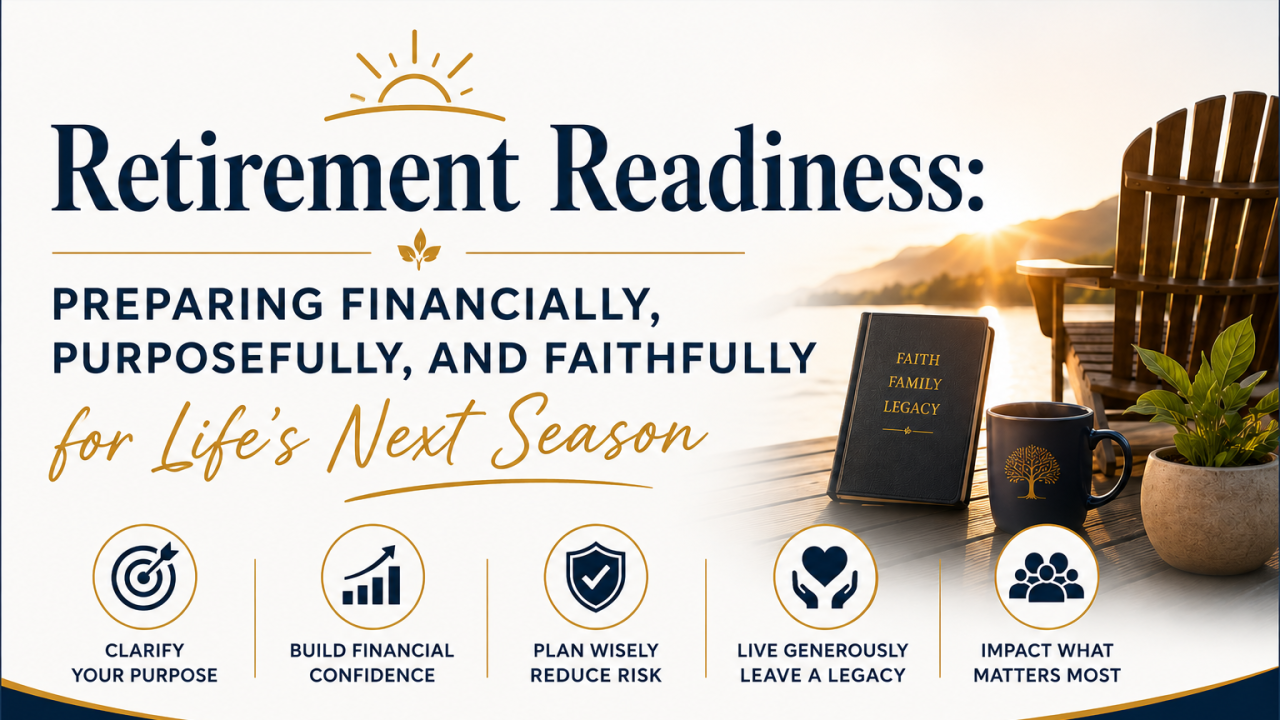
Retirement Readiness: Refiring Purposefully for Life’s Next Season
Retirement Readiness: Refiring Purposefully for Life’s Next Season
Retirement is one of the most significant transitions a person or family will ever experience. Yet for many individuals, retirement preparation focuses almost entirely on investment balances, market returns, and income projections. While those financial considerations are critically important, true retirement readiness should go much deeper.
Retirement is not simply about leaving a profession. It is about entering a new season of life with wisdom, intentionality, stewardship, and renewed purpose. A thoughtful retirement plan should help position individuals and families not only for financial success, but also for peace, flexibility, generosity, significance, and long-term impact. It should align financial decisions with values, family priorities, health considerations, charitable giving, and legacy goals.
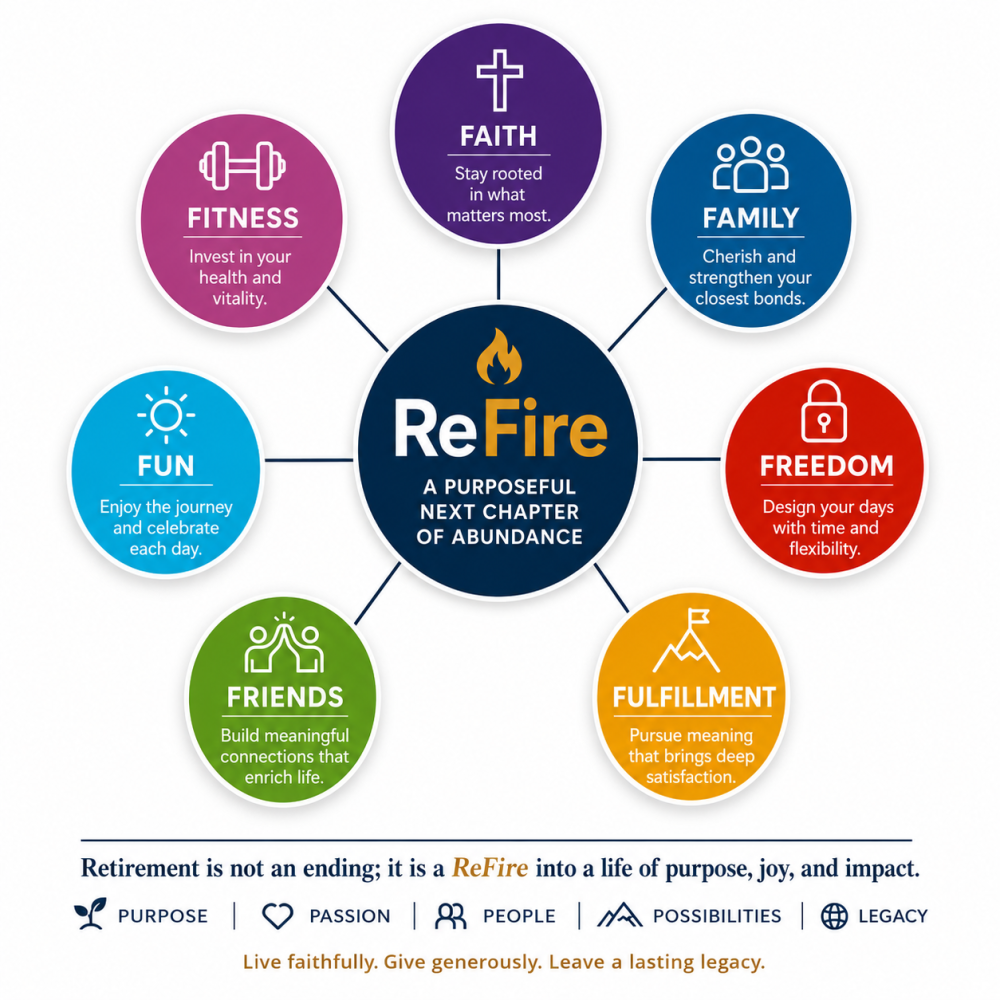
It is vital to retire “to” something meaningful and fulfilling, not just “from” something. It often becomes an opportunity to redirect time, resources, experience, and influence toward the things that matter most. Below are twelve important areas individuals and families should thoughtfully evaluate as they prepare for retirement or what I like to call re-firement.
1. Clarify Your Retirement Vision & Purpose
Before evaluating numbers, projections, or timelines, it is important to first define what retirement actually means for you and your family. For some individuals, retirement means rest and flexibility. For others, it may include ministry, mentoring, volunteering, consulting, travel, charitable work, or investing more intentionally in family relationships and community involvement. Thus, retirement planning should begin with purpose before projections. Here are several important questions to consider:
- What does an ideal retirement season look like?
- How do we want to spend our time?
- What role will service, generosity, family, faith, and community play?
- Do we desire a full retirement or a phased transition into part-time work or consulting?
A meaningful retirement vision often creates greater clarity and direction for every other financial decision that follows.
2. Take Inventory of Your Financial Resources
Many households accumulate retirement assets across numerous accounts over several decades. One of the most valuable early planning exercises is simply organizing and understanding the full financial picture. This includes evaluating:
- 401(k), 403(b), IRA retirement accounts, etc. (tax-deferred growth / general withdrawals are taxed at ordinary rates)
- Roth IRA accounts (qualified withdrawals are tax-free)
- Taxable investment accounts and savings
- Pensions and Social Security benefits
- Cash reserves and emergency funds
- Debt balances and liabilities
- Household cash flow needs, etc.
Entering retirement with organization and clarity can greatly improve financial decision-making and reduce unnecessary stress.
3. Social Security Planning Matters More Than Most People Realize
Social Security decisions are among the most important retirement income choices many families will make. Claiming benefits too early without understanding the long-term consequences can permanently reduce lifetime income, particularly for married couples and surviving spouses. Important planning considerations include:
- Claiming at age 62 versus Full Retirement Age versus age 70
- Spousal and survivor benefit coordination
- Longevity planning
- Taxation of benefits
- Coordination with pensions and investment withdrawals
A thoughtful Social Security strategy can significantly strengthen long-term retirement security.
4. Build a Sustainable Retirement Income Strategy
Retirement planning eventually shifts from wealth accumulation to income distribution. The primary objective becomes creating sustainable, reliable income that supports lifestyle needs while also preserving flexibility for the future. A well-designed retirement income plan should evaluate:
- Reliable income sources
- Withdrawal strategies
- Inflation risks
- Market volatility
- Longevity concerns
- Tax efficiency
- Sequence-of-return risk
The goal is not simply generating income today, but building a strategy designed to support income needs throughout retirement.
5. Evaluate Expenses and Debt Carefully
One of the greatest financial freedoms in retirement often comes from simplicity, flexibility, and margin. As individuals transition into retirement, spending patterns frequently change. Some expenses decrease, while others, such as healthcare, travel, or family support, may increase. Key planning areas include:
- Lifestyle and budget adjustments
- Travel and recreational goals
- Housing expenses and home projects
- Healthcare and insurance costs
- Family support and gifting
- Debt reduction strategies
Wise stewardship often includes continuing to live below one’s means while maintaining flexibility for future needs and opportunities.
6. Tax Planning Becomes Increasingly Important
Retirement planning and tax planning should work together strategically. Many retirees discover that taxes remain one of their largest ongoing expenses during retirement. Coordinating withdrawals and income sources carefully may help reduce lifetime tax exposure. Potential planning opportunities include:
- Roth conversions during lower-income years
- Coordinating taxable, tax-deferred, and tax-free withdrawals
- Managing Required Minimum Distributions (RMDs)
- Monitoring capital gains exposure
- Tax-efficient charitable giving strategies such as Qualified Charitable Distributions (QCDs)
Small tax decisions made consistently over time can create significant long-term impact.
7. Prepare for Healthcare and Medicare Decisions
Healthcare planning is one of the most important and often underestimated components of retirement preparation. Without proper planning, healthcare expenses can place significant strain on retirement cash flow and long-term financial security. Important considerations include:
- Medicare Parts A, B, C, and D
- Medigap versus Medicare Advantage
- Prescription drug coverage
- Coverage gaps before age 65
- Long-term care planning
- Out-of-pocket healthcare expenses
Healthcare planning should be proactive and integrated into the overall retirement strategy.
8. Understand State-Specific Retirement Planning Issues
Where you live during retirement can materially affect taxes, estate planning, and overall lifestyle costs. Some states offer favorable tax treatment for retirement income, while others may impose higher income, property, or estate-related costs. Areas to evaluate may include:
- State taxation of retirement income
- Property tax exemptions and homestead rules
- Residency considerations
- Relocation planning
- State-specific estate planning laws
Retirement planning should account for both federal and state-level considerations.
9. Estate & Legacy Planning Are Essential
Retirement planning is not only about protecting assets during life, but also about transferring wealth, values, and legacy wisely. Estate planning documents should be reviewed regularly to ensure they remain aligned with current wishes, family dynamics, and applicable laws. Important planning areas include:
- Wills and trusts
- Beneficiary designations
- Powers of attorney
- Healthcare directives
- Legacy intentions
- Charitable giving goals
- Organization of important documents and digital information
Thoughtful estate planning can help provide clarity, efficiency, and peace of mind for future generations.
10. Adjust Your Investment Strategy Thoughtfully
As retirement approaches, investment strategies often require refinement and recalibration. The focus typically shifts toward balancing growth, income generation, capital preservation, and risk management. This may involve:
- Reassessing risk tolerance
- Aligning investments with income needs and time horizon
- Improving diversification
- Simplifying unnecessary complexity
- Coordinating tax-efficient asset location across accounts
Investment strategies should support both present income needs and long-term sustainability.
11. Think Beyond the Financials
Retirement is also a major emotional, relational, and lifestyle transition. Many retirees discover that fulfillment during retirement depends just as much on purpose, relationships, and engagement as it does on financial preparedness. Important questions to consider include:
- Should we remain in our current home?
- Would downsizing improve flexibility?
- How will we structure our days and routines?
- Should we continue part-time work or consulting?
- How do we remain connected to community and relationships?
Preparing emotionally and relationally for retirement can be just as important as preparing financially.
12. Continue Growing in Stewardship & Impact
Retirement should not signal the end of meaningful contribution. In many cases, it creates new opportunities for influence, mentorship, generosity, and service. Many individuals find this season allows them to invest more deeply in:
- Mentoring younger generations
- Serving in ministries and nonprofits
- Volunteering and community engagement
- Supporting family intentionally
- Sharing wisdom, experience, and expertise
- Expanding charitable impact
Retirement is not merely an ending. It can become a purposeful re-firing into meaningful labor, service, stewardship and lasting impact.
Final Thoughts
Retirement readiness involves far more than reaching a financial target or a specific account balance. At its core, retirement planning is about stewarding wisely the life, relationships, opportunities, resources, and influence entrusted to us. Thoughtful planning can help individuals and families enter retirement with greater:
- Peace
- Confidence
- Clarity
- Flexibility
- Purpose
- Generosity
- Long-term impact
The ultimate goal is not simply to retire successfully, but to refire into the next season of life faithfully, intentionally, and impactfully with purpose as a faithful steward.
For informational purposes only. Not investment, tax, or legal advice. Investing involves risk, including loss of principal. Past performance does not guarantee future results. For further information please see our full disclosure page: https://wildesfinancial.com/disclosures